
Why Your Legs Suffer on Long Flights (And What Actually Helps)
Compression socks for flights are one of the most effective, lightweight tools for preventing leg swelling, fatigue, and blood clots during air travel.
Here’s a quick look at the different compression levels to compare:
| Compression Level | Best For | Common Materials |
|---|---|---|
| 15-20 mmHg | Everyday travelers, mild swelling | Merino wool, bamboo, nylon |
| 20-30 mmHg | High-risk travelers, medical needs | Synthetic blends, spandex |
When you sit still for hours at cruising altitude, blood naturally pools in your lower legs. Cabin pressure drops, movement is restricted, and dehydration is common — a perfect setup for swollen, achy legs or worse.
A Cochrane review of 12 randomized clinical trials found high-certainty evidence that wearing compression stockings reduced the risk of symptomless deep vein thrombosis (DVT) on flights longer than four hours. And a long-haul flight can make venous thromboembolism (VTE) 1.5 to four times more likely than staying on the ground.
For minimalist travelers, the good news is simple: a single pair of well-chosen compression socks weighs almost nothing, takes up zero extra space, and does a serious job protecting your legs.
This guide compares the essential features so you can find the right pair — and pack just one.

How Graduated Compression Prevents DVT and Swelling
To understand why compression socks for flights are a staple in any lightweight-travel-packing-checklist, we have to look at how blood moves through our bodies. Your heart is a champion at pumping blood down to your toes, but getting that blood back up against gravity while you are wedged into seat 22B is a much harder task.
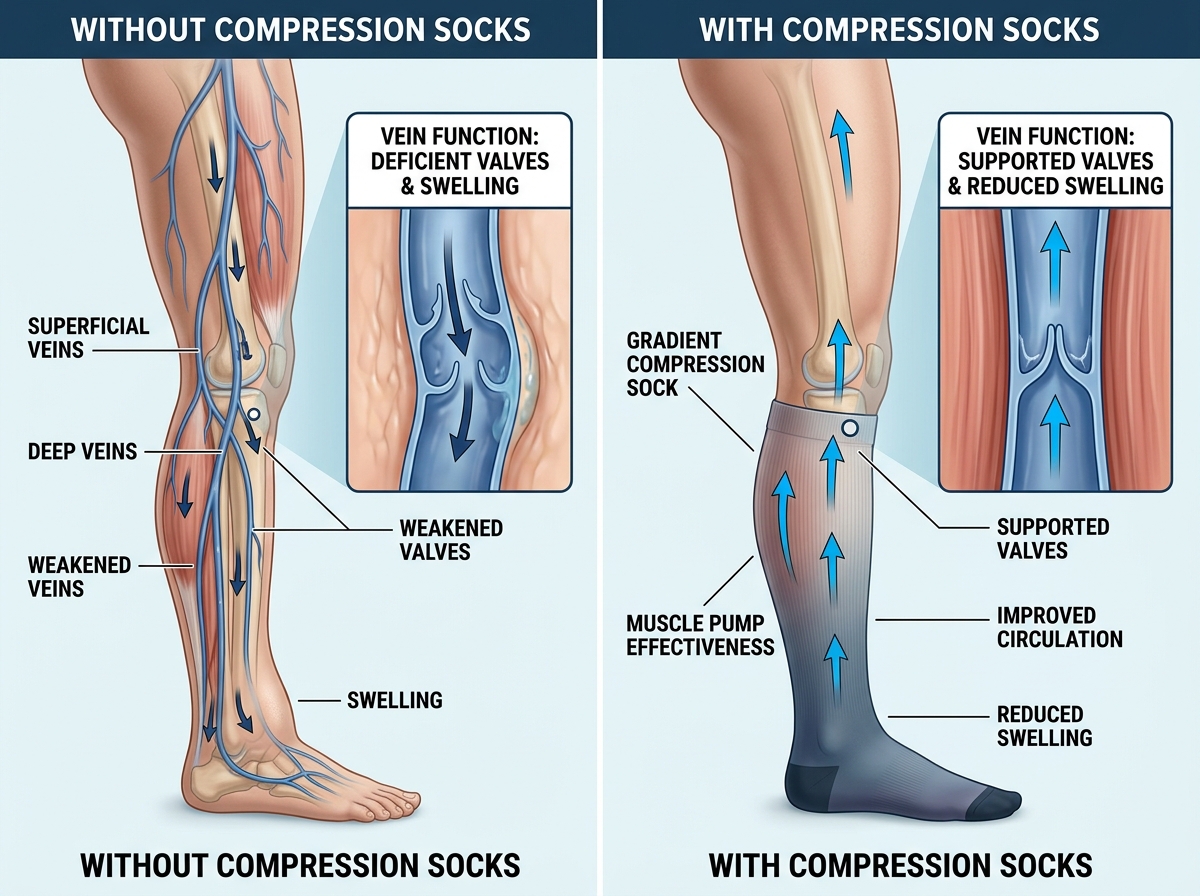
This is where “graduated” pressure comes in. Unlike a regular tight sock that squeezes your leg uniformly, a true travel compression sock is tightest at the ankle and gradually decreases in pressure as it moves up toward the knee. This mechanical “squeeze” mimics the natural pumping action of your calf muscles. It pushes surface-level blood into the deeper vein system, helping it journey back to your heart.
Without this support, fluid can leak out of the blood vessels and into the surrounding tissue, leading to that “sausage-toe” feeling or “heavy legs” after landing. More seriously, sluggish blood flow increases the risk of Deep Vein Thrombosis (DVT)—a blood clot that forms in a deep vein. If a piece of that clot breaks off and travels to the lungs, it becomes a pulmonary embolism (PE), which can be fatal.
The statistics are sobering: in 2020 alone, an estimated 666,000 people in the U.S. were hospitalized with DVT, according to CDC data. While the absolute risk for a healthy person on a single flight is relatively low (about 1 in 4,600 for flights over four hours), the risk factors are cumulative. Think of it like a bucket filling with water; air travel might be the final drop that causes it to overflow.
Choosing Between 15-20 mmHg and 20-30 mmHg Levels
When shopping for compression socks for flights, you will see the unit “mmHg” (millimeters of mercury). This measures the amount of pressure the sock exerts. Choosing the right level is the difference between feeling energized and feeling like your legs are in a vice.
| Feature | 15-20 mmHg (Moderate) | 20-30 mmHg (Firm/Medical Grade) |
|---|---|---|
| Primary Use | Preventing swelling, reducing fatigue, everyday travel. | High-risk DVT prevention, severe varicose veins, post-surgery. |
| Feel | Like a snug, supportive hug. Comfortable for 12+ hours. | Noticeably tight. Can be difficult to put on for beginners. |
| Availability | Over-the-counter (OTC). | Often recommended by doctors; “Store-bought” medical grade. |
| Best For | Minimalist travelers, pregnant flyers with mild swelling. | Frequent flyers with history of clots or circulatory issues. |
For most of us looking for essential-gear-for-the-minimalist-traveller, the 15-20 mmHg range is the “sweet spot.” It provides enough pressure to keep circulation moving and prevent leg achiness without being so restrictive that you want to rip them off mid-flight.
If you have a family history of blood clots or are managing a specific medical condition, a 20-30 mmHg sock offers that extra “spicy” level of compression. Just keep in mind that these are harder to pull on in a cramped airplane bathroom!
Who Should Prioritize Compression for Air Travel?
While anyone can benefit from arriving at their destination with “fresh” legs, certain groups should consider compression socks for flights a non-negotiable part of their must-have-travel-essentials-for-solo-beginners.
- Pregnant Travelers: Pregnancy naturally increases blood volume and changes blood chemistry, making clots more likely. Many moms-to-be find that compression socks become a total necessity around the seven-month mark to manage “cankles” and leg heaviness.
- Frequent Flyers & “Road Warriors”: If you spend more time in the air than on the ground, the cumulative effect of cabin pressure and immobility adds up.
- Elderly Passengers: As we age, our vein valves can become less efficient. Compression socks provide the external support those valves need.
- Those with High-Risk Factors: This includes smokers, individuals with obesity, or those taking estrogen-based medications (like certain birth controls), as these factors can “fill the bucket” of VTE risk.
If you are just starting your travel journey, check out our lightweight-travel-packing-checklist-for-beginners to see how these fit into a streamlined kit.
Top-Rated Features of Compression Socks for Flights
Not all socks are created equal. Since we prioritize comfort and convenience at Pleno Comercio, we look for specific features that make a sock worth its weight in your carry-on. Here is what to look for in travel-gear-essentials-every-minimalist-traveler-should-have.
Material Matters: Merino, Bamboo, and Charcoal
The best travel socks use technical blends. Merino wool is a minimalist’s dream—it regulates temperature (keeping you warm on icy planes and cool on the tarmac), wicks moisture, and is naturally odor-resistant. Bamboo rayon adds a silky softness and breathability, while bamboo charcoal is specifically designed to stay fresh during long-haul journeys.
The “Must-Have” Design Elements
- Seamless Toe: There is nothing worse than a thick seam rubbing against your toes for 10 hours. Look for “seamless linked toe cages” to prevent blisters.
- Arch Support: Extra elastic around the midfoot helps keep the sock in place and provides a bit of a lift for tired arches.
- Wide-Calf Options: Compression shouldn’t be “one size fits most.” Brands that offer specific wide-calf sizing ensure the top band doesn’t act like a tourniquet.
- Ease of Donning: Some high-tech socks are designed with a weave that makes them easier to pull on and off in tight spaces.
Sizing, Care, and Alternatives for Travelers
To get the most out of your compression socks for flights, you need to treat them right. A sock that is too big won’t compress, and one that is too small can actually restrict blood flow.
How to Size Correctly
Don’t just go by shoe size! For the best fit, use a soft tape measure to find the circumference of your calf at its widest point. Most premium brands use this measurement as their primary sizing guide, with shoe size as a secondary check. If you are between sizes, we usually recommend sizing down to ensure you get the intended compression level.
Care and Maintenance
For the minimalist traveler, durability is key.
- Washing: Turn them inside out and machine wash on cold or warm.
- Drying: Air dry only. High heat from a dryer can break down the Lycra and spandex fibers that provide the compression. If you’re on the go, roll them in a dry towel to squeeze out excess moisture and hang them up; they usually dry overnight.
- Replacement: Even the best socks lose their “snap.” Expect to replace your travel compression socks every 6–9 months if you use them frequently.
In-Flight Alternatives and Add-ons
While socks are the heavy lifters, they aren’t the only way to stay healthy. For a truly essential-items-for-one-bag-travel experience, combine your socks with these habits:
- The “Seated Dance”: Flex your calf muscles, roll your ankles in big circles (both directions), and wiggle your toes every hour.
- Hydration: Drink plenty of water. Dehydration thickens the blood, making clots more likely.
- Movement: If the “Fasten Seatbelt” sign is off, take a short walk to the galley and back every two hours.
Frequently Asked Questions
When should I put on my compression socks for flights?
We recommend putting them on 30–60 minutes before takeoff. This allows your legs to adjust to the pressure before you even board. Putting them on while you’re already in a cramped airplane seat is a workout nobody needs! By wearing them early, you prevent blood from even starting to pool during the boarding process. Check out more must-have-travel-essentials-for-solo-beginners-2 for a smooth departure.
Are there any risks to wearing compression socks for flights?
While safe for most, people with advanced arterial disease, certain skin infections, or limited sensation in their legs (like severe neuropathy) should avoid them. A major risk is the “tourniquet effect”—this happens if the sock is too long and you roll the top down, creating a tight band that actually blocks circulation. Always keep them pulled smooth. If you have underlying heart or circulation issues, a quick medical consultation is a smart move.
Can I sleep in compression socks during a long-haul trip?
Yes, you can. While compression socks are most effective when you are upright (fighting gravity), they are safe to wear while sleeping on an overnight flight. However, once you reach your hotel and can lie completely horizontal in a bed, your body doesn’t need the extra help. It’s best to take them off then to let your skin breathe. See our travel-essentials-for-solo-travelers guide for more tips on surviving long-haul journeys.
Conclusion
At Pleno Comercio, we believe that travel should be about the destination, not the physical toll of the journey. Compression socks for flights are the ultimate minimalist hack: they are small, lightweight, and provide a massive boost to your post-flight well-being. Whether you choose a soft merino blend for a cross-country hop or a firm medical-grade pair for a trip across the Pacific, your legs will thank you the moment you step off the plane.
Ready to streamline your carry-on with gear that actually works? Shop Travel Gear Essentials and arrive at your next destination fresh, energized, and ready to explore.
