
Why Your Carry On Backpack List Can Make or Break Your Trip
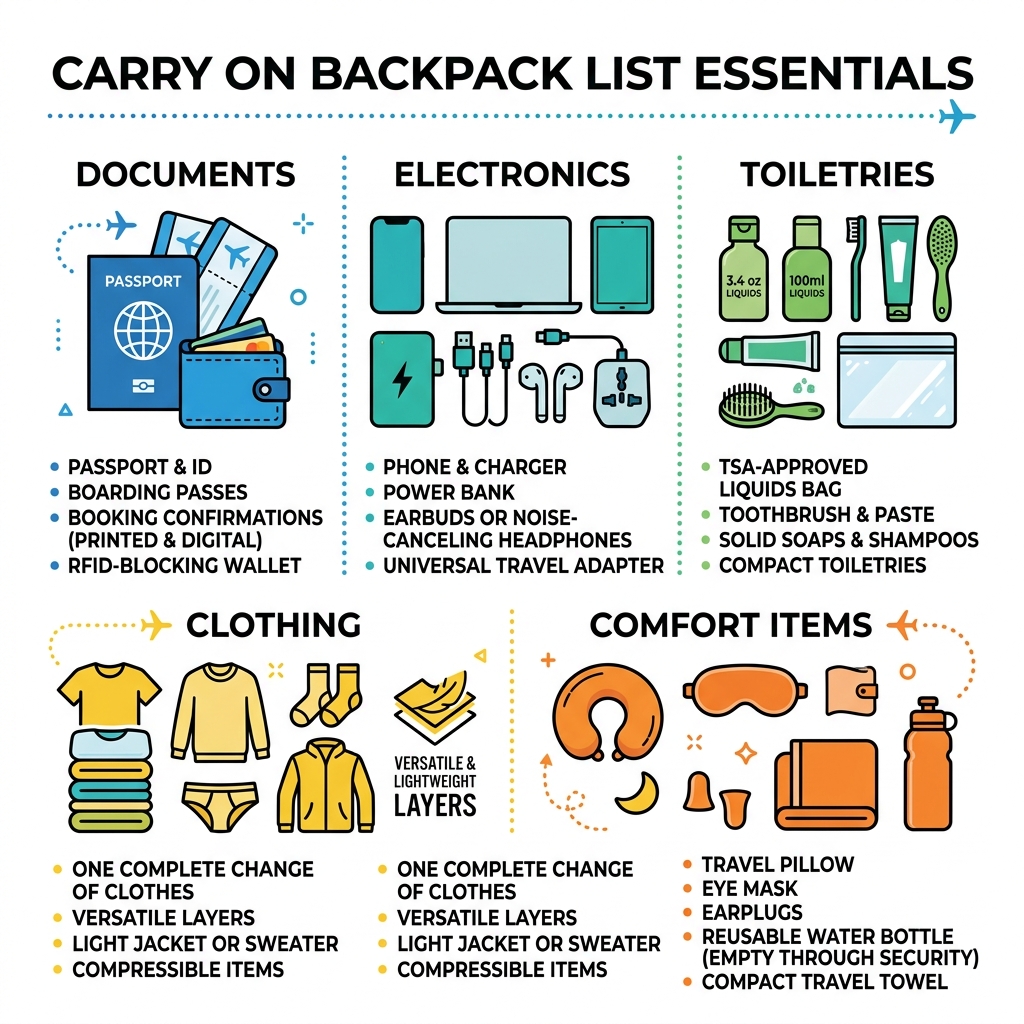
A solid carry on backpack list is the difference between breezing through airports and dragging overstuffed luggage you’ll regret by day two. Here’s a quick-reference list of what belongs in every carry-on backpack:
Essential Carry On Backpack List:
- Travel documents – passport, boarding pass, ID, and digital backups
- Electronics – phone, power bank, earbuds, universal adapter, laptop or tablet
- Toiletries – TSA-approved liquids (3.4 oz or less) in a clear quart-sized bag
- Medications – prescriptions and basic first-aid items
- Clothing – one change of clothes plus lightweight, versatile layers
- Valuables – RFID-blocking wallet, cash, and cards
- Comfort items – travel pillow, eye mask, earplugs or noise-canceling earbuds
- Snacks and hydration – reusable water bottle and portable snacks
- Entertainment – e-reader, downloaded movies, or a book
- Security extras – luggage lock, money belt, or crossbody bag
Getting this list right takes more trial and error than most people expect. One experienced traveler described packing for a 23-day, four-country Europe trip and realizing that every extra item you bring becomes a burden you carry with every step. Budget airlines make it even harder, constantly shifting weight limits and size rules that can catch unprepared travelers off guard.
The good news: with the right backpack and a smart packing strategy, you can travel lighter, move faster, and skip the checked baggage carousel entirely.
Choosing the Ultimate Carry On Backpack List for Your Needs
Selecting the right vessel for your gear is the most critical step in mastering the one-bag lifestyle. We believe that a backpack isn’t just a bag; it’s your mobile home for the duration of your journey. If it’s poorly organized or uncomfortable, even the most curated carry on backpack list won’t save your aching shoulders.
When browsing for the perfect pack, look for a “clamshell” or “suitcase-style” opening. Unlike traditional top-loading hiking packs where the item you need is always at the very bottom, clamshell bags zip open entirely, allowing you to see everything at once. This is a game-changer for staying organized on the road.

Finding an Airline Compliant Carry On Backpack List
The “perfect” bag doesn’t exist if it’s too big to fit in the overhead bin. Most major airlines stick to a standard size of 22 x 14 x 9 inches (56 x 36 x 23 cm), but budget carriers in Europe and Asia can be much stricter. Some low-cost airlines now require your “carry-on” to fit entirely under the seat in front of you, which usually limits you to a 20L to 30L bag.
To stay compliant, we recommend a bag in the 35L to 45L range for standard carry-on use. Statistics show that specialized 40L to 45L travel-specific backpacks are traveler favorites because they maximize every inch of the allowed dimensions. Always check your specific airline’s weight limits too; while US domestic flights rarely weigh carry-ons, international budget airlines often enforce a 7kg (15.5 lbs) limit. For more details on selecting the right dimensions, check out the best carry-on luggage for minimalist travellers.
Comfort and Durability Features
If you plan on walking more than ten minutes with your bag, comfort features are non-negotiable. Look for:
- Padded Hip Belts: A good hip belt can transfer up to 80% of the weight from your shoulders to your hips.
- Airflow Back Panels: These prevent the dreaded “sweaty back” syndrome by creating a gap for ventilation.
- Load Lifters: Small straps at the top of the shoulder pads that pull the bag closer to your body for better balance.
Durability is equally important. High-denier nylon or water-resistant coatings protect your electronics from unexpected rain showers. For those navigating city streets and transit hubs, stylish and durable backpacks for urban commuters offer a blend of professional aesthetics and rugged build quality. A bag that fits perfectly into an overhead bin is only useful if it doesn’t fall apart halfway through your trip. More carry-on-only-travel-planning-tips can help you narrow down the technical specs.
Essential Packing Categories for Every Traveler
Once you have the bag, it’s time to fill it. The secret to a successful carry on backpack list is categorization. If you just throw everything into the main compartment, you’ll be digging through a mountain of socks to find your passport. We suggest breaking your gear into four main “buckets”: Clothing, Toiletries, Electronics, and Essentials.
Clothing and Versatile Layers
The “Capsule Wardrobe” is the holy grail of minimalist travel. The goal is to bring a small number of items that all match each other. Stick to a neutral color palette (blacks, greys, navys) so you can mix and match every top with every bottom.
Prioritize performance fabrics. Merino wool is a favorite among one-bag travelers because it is naturally odor-resistant and moisture-wicking—you can often wear a merino shirt for three days straight without it smelling. Avoid heavy cotton, which takes forever to dry and wrinkles easily. For a deep dive into building your wardrobe, see our guide on mastering the art of carry-on-only-packing.
Toiletries and the 3-1-1 Rule
TSA’s 3-1-1 rule is the bane of the over-packer’s existence: 3.4oz (100ml) containers, in 1 quart-sized clear bag, for 1 passenger. To conquer this, we recommend switching to solid toiletries. Solid shampoo bars, conditioner bars, and even toothpaste tabs don’t count as liquids, freeing up space in your quart bag for things like sunscreen or expensive serums.
Always use leakproof silicone bottles for the liquids you do bring. There is nothing worse than arriving in Italy only to find your favorite moisturizer has exploded over your clean white shirts. For a checklist of what to include in your kit, check backpack-essentials-for-one-week-adventures.
Electronics and Tech Management
In 2025, our “tech” often takes up more room than our clothes. To keep things streamlined:
- Universal Adapter: One high-quality adapter that works in 200+ countries is better than five individual ones.
- Power Bank: Ensure it meets FAA guidelines (usually under 100Wh). A 20,000mAh bank is typically the sweet spot for charging a phone 3-4 times.
- Tech Organizer: A small pouch for cables prevents the “spaghetti mess” at the bottom of your bag.
Don’t forget to download your entertainment (movies, podcasts, books) before you leave for the airport. Relying on patchy plane Wi-Fi is a recipe for boredom. Learn how to organize your one bag travel backpack like a pro to keep your chargers accessible during layovers.
Strategies for Maximizing Space and Organization
How you pack is just as important as what you pack. If you simply fold your clothes, you’re leaving a lot of “dead air” in your bag. We want to eliminate that air to fit more into our carry on backpack list.
Using Tools for an Organized Carry On Backpack List
Packing cubes are the single most effective tool for any traveler. They act like drawers for your backpack. You can have one cube for tops, one for bottoms, and a small one for socks and underwear. This not only compresses your clothes but also makes it incredibly easy to find what you need without unpacking the whole bag.
Some travelers prefer compression cubes, which use an extra zipper to squeeze out even more air. If you’re really tight on space, tech organizers and dedicated shoe bags (to keep dirty soles away from clean clothes) are essential. Discover more about these tools in our guide to unlocking space-saving hacks for backpack packing.
Space-Saving Hacks for Minimalists
If you’re struggling to zip that bag shut, try these pro tips:
- Wear Your Bulk: Always wear your heaviest shoes (like boots) and your bulkiest jacket on the plane. You can always take the jacket off and use it as a pillow once you’re on board.
- The “Bundle Wrap” or “Ranger Roll”: Rolling your clothes tightly instead of folding them prevents wrinkles and saves a massive amount of space.
- Multi-use Gear: A large linen scarf can be a blanket on a cold plane, a beach towel, or a privacy screen in a hostel.
For more “secret” tips, check out how to maximize space in small backpacks and our top backpack space saving secrets.
Security and Comfort: Protecting Your Valuables
A backpack is convenient, but it can also make you a target for pickpockets in crowded tourist areas. Your carry on backpack list must include security measures to protect your most important assets.
Securing Important Documents
Never keep all your eggs in one basket. We recommend keeping your physical passport in a secure, RFID-blocking pocket (many travel backpacks have a “hidden” pocket against your back). Simultaneously, keep digital copies of your passport, visas, and insurance on a secure cloud drive and an offline folder on your phone.
Using a small crossbody bag or “fanny pack” for your phone and wallet while walking around a city is often safer than keeping them in your backpack’s outer pockets. For a list of bags with integrated security features, see the top 20 travel backpacks for one-bag journeys.
Health and In-Flight Comfort
Long-haul flights are an endurance sport. To survive them, your carry on backpack list should include:
- Compression Socks: To prevent “heavy feet” and swelling.
- Hydration: A collapsible water bottle you can fill up after security.
- Sanitation: Hand sanitizer and wipes for the tray table (statistically one of the filthiest spots on the plane).
- Sleep Aids: A supportive wraparound neck pillow or a high-quality memory foam version can be the difference between three hours of sleep and a neck cramp.
A well-chosen backpack is the ultimate companion for navigating the Metro in Paris or the cobblestones of Rome, where mobility and speed are essential. For more insights, check out the best backpacks for one-bag travel in 2022.
Frequently Asked Questions about Carry-On Packing
What items are strictly prohibited in a carry-on backpack?
Beyond the obvious (weapons, explosives), many travelers get caught by:
- Large Liquids: Anything over 3.4oz, including peanut butter or spreads (they count as liquids!).
- Sharp Objects: Large scissors or certain multi-tools.
- Batteries: Loose lithium batteries must be in carry-on, never checked, but they must be under certain Wh limits.
- Aerosols: Some personal care aerosols are okay, but self-defense sprays (like pepper spray) are strictly banned.
How do I fit two weeks of clothing into one backpack?
It sounds impossible, but it’s all about the “Rule of Three”: wear one, wash one, dry one. If you pack for one week and do a load of laundry (or sink-wash your basics) halfway through, you can travel indefinitely. Using a capsule wardrobe and compression cubes makes this much easier.
Why is a backpack ideal for international travel?
A backpack allows you to keep your hands free for maps, coffee, or holding onto a rail on a moving train. It also encourages you to pack lighter, which makes the entire travel experience less stressful. You rarely have to worry about “gate checking” a backpack because its flexible shape can almost always be squeezed into tight overhead compartments.
Conclusion
At Pleno Comercio, we believe that travel is about the experiences you have, not the things you carry. Our philosophy is rooted in minimalism—providing you with the curated, lightweight essentials that make your journey smoother without the clutter. By following this carry on backpack list and choosing gear that prioritizes comfort and convenience, you’re not just packing a bag; you’re unlocking a more liberated way to see the world.
Ready to lighten your load and upgrade your travel game? Shop minimalist travel gear at Pleno Comercio and find the perfect companions for your next adventure. Happy travels!
