Container Flowers for Shade: Color Without Full Sun
Which flowers and foliage plants bring color to pots on a shaded porch or under trees, how to design a pot that shows up in dim light, and how watering and care change when the sun is scarce.

A north-facing porch or a patio under trees can look like a lost cause when every plant bench seems to be full of sun lovers. It is not. There is a good range of container flowers for shade, and some of the most striking pots you can plant rely on colored leaves as much as on blooms.
The trick is to be honest about how much light you have, choose plants that are sold for it, and adjust your care a little, because a pot in shade behaves differently from one in sun. Directions here assume the Northern Hemisphere, where north-facing spots get the least direct sun.
What kind of shade do you have?
Shade is not one thing, and the differences decide what will grow.
- Bright open shade. No direct sun, but plenty of open sky overhead, as on the north side of a house or under a high porch roof. Most plants in this guide do well here.
- Part shade. A few hours of direct sun, ideally gentle morning sun, then shade for the remainder of the day. This widens your choice a good deal.
- Deep shade. Dim all day, as under dense evergreens or in a narrow passage between tall walls. Very little will flower here.
If you are unsure which you have, the guide to reading the light for a container garden shows how to time the sun on a clear day. And if your count reaches six hours or more of direct sun, you are better served by the flowers that suit pots in full sun.
Flowers that bloom in lower light
- Impatiens. Low mounds covered in flat flowers in white, pink, red, orange and violet. They are among the most dependable bloomers for shade and wilt quickly when the mix dries, which makes them a useful signal plant.
- Wax begonias. Compact, glossy plants with small flowers and green or bronze leaves. They are tidy, need no deadheading and cope with a range of light.
- Tuberous begonias. Much larger, often double flowers in rich colors, with upright and trailing forms. They prefer shelter from wind and a mix that drains freely.
- Fuchsia. Drooping two-tone flowers, lovely in a hanging basket where you can see them from below. Fuchsia prefers cool conditions and often struggles in hot, humid summers.
- Torenia (wishbone flower). Small trumpet flowers, commonly in blue, purple, pink and yellow, on mounding or trailing plants that take warm, humid weather in stride.
- Lobelia. A haze of tiny blue, white or purple flowers at the rim of a pot. It is at its best in mild weather and commonly fades when summer turns hot.
Foliage that does the work of flowers
Leaves last all season and never need deadheading, so in shade they are often the backbone of a pot.
- Coleus. Leaves patterned in burgundy, lime, pink, orange and near-black. Pinching out the growing tips keeps plants bushy.
- Caladium. Large heart-shaped leaves in pink, red, white and green. It needs real warmth and sulks in cold mix, so it goes out late.
- Heuchera (coral bells). Ruffled mounds in purple, caramel, lime and silver. It is a perennial, so it can stay in its pot for more than one year in many climates.
- Ferns. Fine green texture that sets off bolder leaves and bright flowers.
- Sweet potato vine. Fast-growing trailing stems with chartreuse or dark purple leaves. It grows best with some sun, so use it in part shade, not deep shade.

Designing a pot that shows up in dim light
Dark colors disappear in shade. Deep purple flowers in a charcoal pot can be almost invisible from across the patio, while the same corner planted in pale tones seems to glow.
- Lean on white, pale pink, soft yellow and lime green, which reflect the light there is.
- Use pale or brightly glazed pots so the container itself stands out.
- Put one dark-leaved plant beside a light one for contrast, not several dark ones together.
- Mix leaf sizes: a broad caladium leaf next to a lacy fern reads clearly even at a distance.
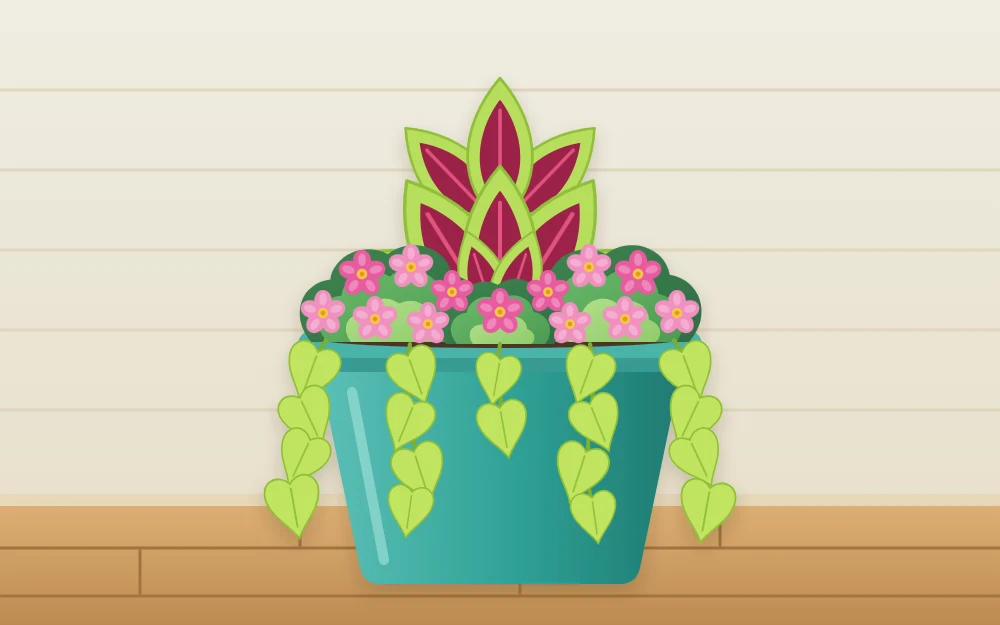
A simple combination to try in one wide pot is a tall coleus in the center, begonias around it and a chartreuse sweet potato vine at the rim. That arrangement follows the thriller, filler, spiller approach to mixed containers, which works just as well in shade as in sun, provided every plant in the pot wants the same light.
How care differs in shade
With less sun and usually less wind, the potting mix in a shaded pot dries more slowly. That makes it easy to water too often. Conditions vary from pot to pot, so feel the mix a couple of inches down and water only when it is dry at that depth. Make sure the drainage holes are clear, and empty saucers after rain.
Growth is slower too. Plants take longer to fill a pot than they would in sun, so it is reasonable to plant a little more closely than the widest spacing on the plant tag, while still leaving room for air to move. Slower growth also means plants use fewer nutrients; if you feed, follow the fertilizer label and do not exceed it.
Tip
Slugs and snails like damp shade and feed at night, leaving ragged holes and silvery trails. Check under pot rims and saucers in the evening and pick them off by hand, and raise pots on pot feet so there are fewer damp hiding places underneath.
Be realistic about deep shade
Deep shade under dense evergreens supports very little. The light is low all year, the tree canopy sheds rain away from the pots, and fallen needles collect on the mix. Flowering plants set there usually stretch, pale and stop blooming.
You have a few honest options. Ferns and some other foliage plants may hold on where flowers will not. Pots can be moved, so a container can spend most of its time in a brighter spot and visit the dark corner for an occasion. Sometimes raising the lowest branches of a tree, or shifting the pots a few feet toward open sky, is enough to turn deep shade into bright open shade.
Good to know
Most shade annuals are tender. Impatiens, begonias, coleus and caladium are damaged by frost and dislike cold nights, so wait until frost danger has passed in your area and nights are mild before putting them out.
Frequently asked questions
What flowers bloom in full shade in pots?
In bright open shade with no direct sun, impatiens and wax or tuberous begonias are the most dependable bloomers, and torenia and fuchsia can also do well. In truly deep shade, such as under dense evergreens, very little flowers at all, and foliage plants such as ferns are the more realistic choice.
Do shade containers need less water than sun containers?
Often they do, because the mix dries more slowly without direct sun, but it varies with pot size, plant size, wind and weather. A basket full of large impatiens can still dry quickly on a warm, breezy day. Feel the mix a couple of inches down and water when it is dry there.
Can sun-loving flowers grow on a shady porch?
They usually survive but perform poorly. Sun lovers such as zinnias and marigolds tend to grow tall and thin and produce few flowers when they get much less light than the plant tag asks for. Matching plants to the light you have gives far better results than hoping a plant will adapt.