Container Gardening Mistakes: 10 Common Beginner Errors
Ten common reasons pots struggle, from missing drainage holes to crowded planting, with a plain explanation of why each one matters and what to do differently this year.
If your pots struggled last year, the cause was probably ordinary. Most container gardening mistakes are simple, common and easy to make with the best of intentions, and nearly all of them trace back to the fact that a pot is a small, closed world where little problems grow quickly.
Here are ten of the most frequent errors, grouped by where they happen, with the reason each one matters and what to do instead. Every one of them is fixable, often in a few minutes.
Mistakes With the Pot
1. No drainage holes
A handsome pot with a solid base is a trap. Water has nowhere to go, the mix at the bottom stays saturated, and roots that sit in it are starved of air and may rot.
Instead: buy pots with holes, add holes where the material allows it, or use the solid pot as a decorative outer cover around a plain pot that drains. The guide to container drainage explains each option.
2. A pot too small for the plant
Small pots hold little mix, so they dry fast, heat up fast and leave roots cramped. A plant that looked fine in spring can be wilting by lunchtime once it has grown.
Instead: choose the pot for the size the plant will reach, not the size it is today. Check the plant tag, and see what size pot you need for commonly suggested starting points.
A Mistake With the Mix
3. Filling pots with garden soil
Soil from the yard seems like a free and natural choice, but in a container it packs down, drains slowly and squeezes out the air that roots need. It can also bring weed seeds and disease with it.
Instead: use a bagged product sold as potting mix or container mix. The article on potting mix for containers shows how to read the bag so you bring home the right thing.
Mistakes With Water
4. Watering by the calendar
A fixed timetable feels responsible, but pots do not dry on a timetable. A small pot in hot, windy weather may need water more than once in a day, while a large pot in cool shade can stay moist for many days. Conditions vary from pot to pot and from week to week, so a routine that suited a cool spell can leave plants parched in a hot one, or drowned in a rainy one.
Instead: check before you water. Push a finger a couple of inches into the mix, or lift the pot to feel its weight. The full method is in the guide on how to water container plants.
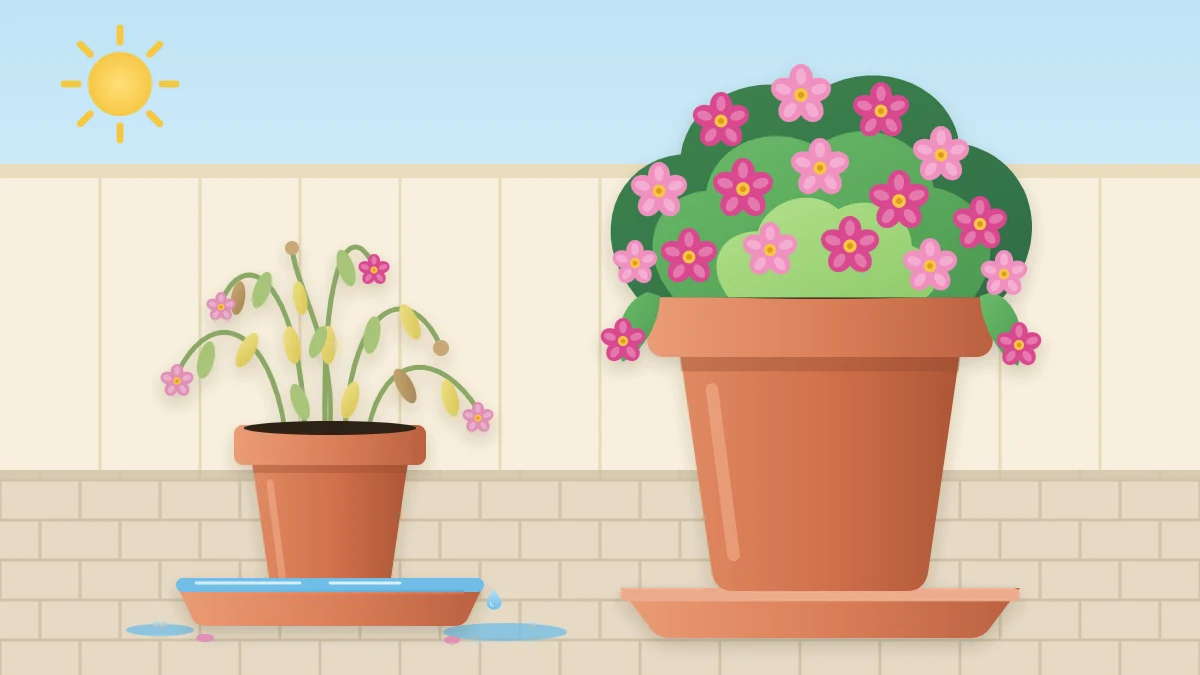
5. Letting saucers stay full
A saucer protects a deck or a floor, but a pot standing in a full one is effectively a pot without drainage. The lower part of the mix stays wet and the roots there suffer.
Instead: tip saucers out after watering and after rain. Outdoors, raising pots on pot feet keeps the holes clear and lets water run away.
Good to know
A wilting plant is not always a thirsty one. Wilting can come from dry mix or from waterlogged, damaged roots, and adding water to the second case makes things worse. Feel the mix at depth before you reach for the watering can.
Mistakes With Light and Timing
6. Sun plants in shade, or shade plants in sun
A sun-loving plant in a dim corner often grows leggy and flowers poorly. A shade plant in hot afternoon sun may scorch and wilt. Extra water or fertilizer cannot make up for the wrong light.
Instead: watch your spot on a clear day, count the hours of direct sun and choose plants whose tags match. Full sun usually means about six hours or more.
7. Planting out before cold nights have passed
The first warm weekend of spring is tempting, but tender plants such as tomatoes, peppers, basil and many summer flowers are damaged by frost and stall in cold mix. Plants set out too early often sit still for weeks, and later plantings can overtake them.
Instead: wait until the danger of frost has passed in your area and nights are staying mild. Your local extension service can tell you the average last frost date.
Mistakes at Planting Time
8. Crowding too many plants into one pot
Young plants look small, so it is natural to squeeze in a few extra for an instant full effect. Within weeks they are competing for the same limited water, nutrients and light. Crowded pots dry out faster, and the weaker plants decline.
Instead: use the mature width and spacing on the plant tag. A pot that looks a little sparse on planting day usually fills in quickly.

9. Mixing plants with very different needs
A pot gets one watering routine and one position. If you combine a plant that likes to dry out between waterings with one that needs steady moisture, or a sun lover with a shade lover, one of them will always be unhappy.
Instead: group plants that want the same light and similar moisture. Rosemary and thyme make good pot partners, for example, while basil is better with parsley. Check the tags side by side before you buy.
A Mistake Later in the Season
10. Never feeding after the first weeks
Potting mix holds few nutrients, and what it has is used up or washed out by repeated watering. Pots that start strongly and then fade to pale leaves and fewer flowers in midsummer are often hungry, although low light, crowded roots and watering problems can look similar.
Instead: plan to feed during the growing season with a fertilizer made for container plants. Read the potting mix bag to see whether it already contains fertilizer, then follow the fertilizer label and do not exceed it. More is not better.
Every One of These Is Fixable
None of these errors means you lack a green thumb. They are the ordinary lessons of a first season or two, and most can be corrected as soon as you spot them. A quick review before you plant covers the main points:
- The pot has drainage holes and is big enough for the full-grown plant.
- It is filled with potting mix, not garden soil.
- The plants match the light and match each other.
- Frost danger has passed for tender plants.
- You water by checking the mix, empty the saucers and feed according to the label.
Change one or two things this year and watch how quickly the pots respond.
Frequently asked questions
Why do container plants keep dying?
There is rarely a single reason. Common contributors include a pot without drainage holes, a container that is too small, garden soil in place of potting mix, light that does not match the plant and watering without checking the mix first. Work through those basics one at a time to narrow it down.
Can I fix a pot that has no drainage holes?
Often, yes. Plastic, wood and metal can usually be drilled, with eye protection and a suitable bit. Ceramic and concrete need the right bit and can crack. If drilling is not practical, grow the plant in a plain pot with holes and set that inside the solid one as a decorative cover.
Is it too late to correct mistakes in the middle of the season?
Usually not. A pot can be moved to better light, a crowded planting can be thinned, a root-bound plant can go into a larger container and saucers can be emptied at any time. Plants in pots tend to respond within a few weeks once the underlying problem is eased.